Results from the Lightspeed Project
Science highlights from proto-Lightspeed commissioning
Optical Pulsar PSR B0540−69
proto-Lightspeed observed the 51 ms optical pulsar PSR B0540−69 in the Large Magellanic Cloud for 4.3 minutes with 3 ms exposures in December 2025 (Figure a). The resulting pulse profile quality is comparable to 7.13 hours of previous observations from Iqueye. An electron counting technique enabled by the detector's deep sub-electron read noise further reduced noise in the pulse profile.
Black Hole X-ray Binary GX 339-4
Observations of the black hole X-ray binary GX 339-4 at 100 Hz sampling in September 2025 revealed optical flaring on timescales as short as 10 milliseconds (Figure b). This rapid variability, showing brightening by a factor of over 7, was previously unresolved in observations at 20 Hz frame rates.
Narrow-band Imaging
A 15 minute [OIII] exposure of a nearby dwarf galaxy (DESI ID 39627905885538609, distance 19.7 Mpc) demonstrated proto-Lightspeed's capability for high signal-to-noise narrow-band imaging (Figure c). The image is dominated by shot noise from the sky background, with Magellan's excellent angular resolution enabling detailed study of the multi-phase interstellar medium.
Ultracompact Binary ATLAS J1013−4516
proto-Lightspeed observed the mass-transferring white dwarf binary ATLAS J1013−4516 (G = 19.5 mag, orbital period 8.56 minutes) with 1 second integrations in December 2025 (Figure d). The high-cadence observations sharply resolved the system's highly structured eclipse morphology, delivering the most precise individual eclipse timings for this system to date.
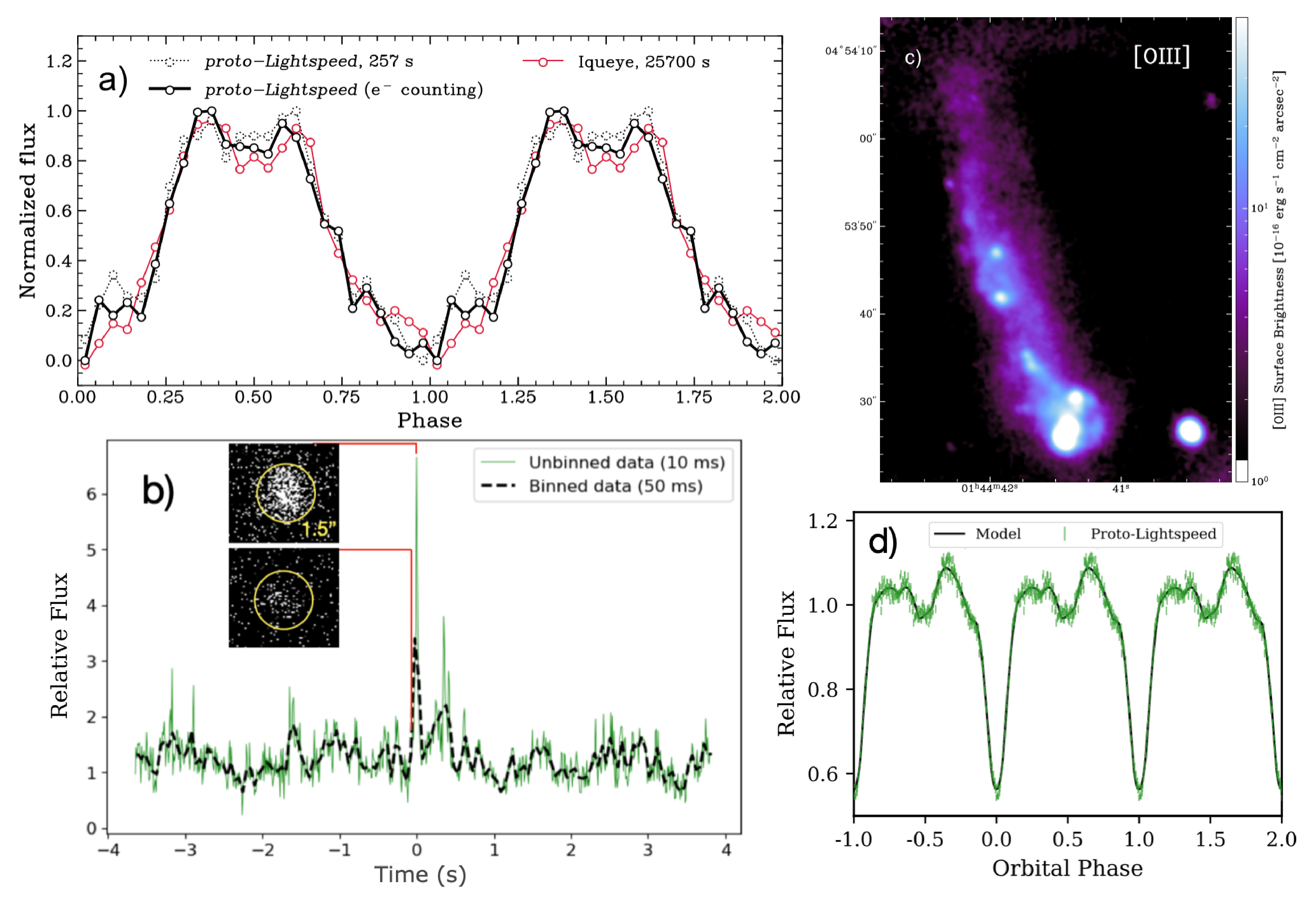
Figure: Representative observations from proto-Lightspeed commissioning. (a) Phase-folded light curve of optical pulsar PSR B0540−69 showing 51 ms pulsations obtained in 4.3 minutes. The solid black line uses electron counting to reduce noise. Red shows previous 7.13 hour Iqueye observations for comparison. (b) Light curve of black hole X-ray binary GX 339-4 at 100 Hz (green) showing rapid flaring on 10 ms timescales. Black dashed line shows how the flares appear at 20 Hz sampling. (c) 15 minute [OIII] narrowband image of nearby dwarf galaxy DESI ID 39627905885538609. (d) Phase-folded light curve of ultracompact binary ATLAS J1013−4516 (8.56 minute period) observed with 1 second cadence, with model fit shown in black.