proto-Lightspeed
Design
Optical System
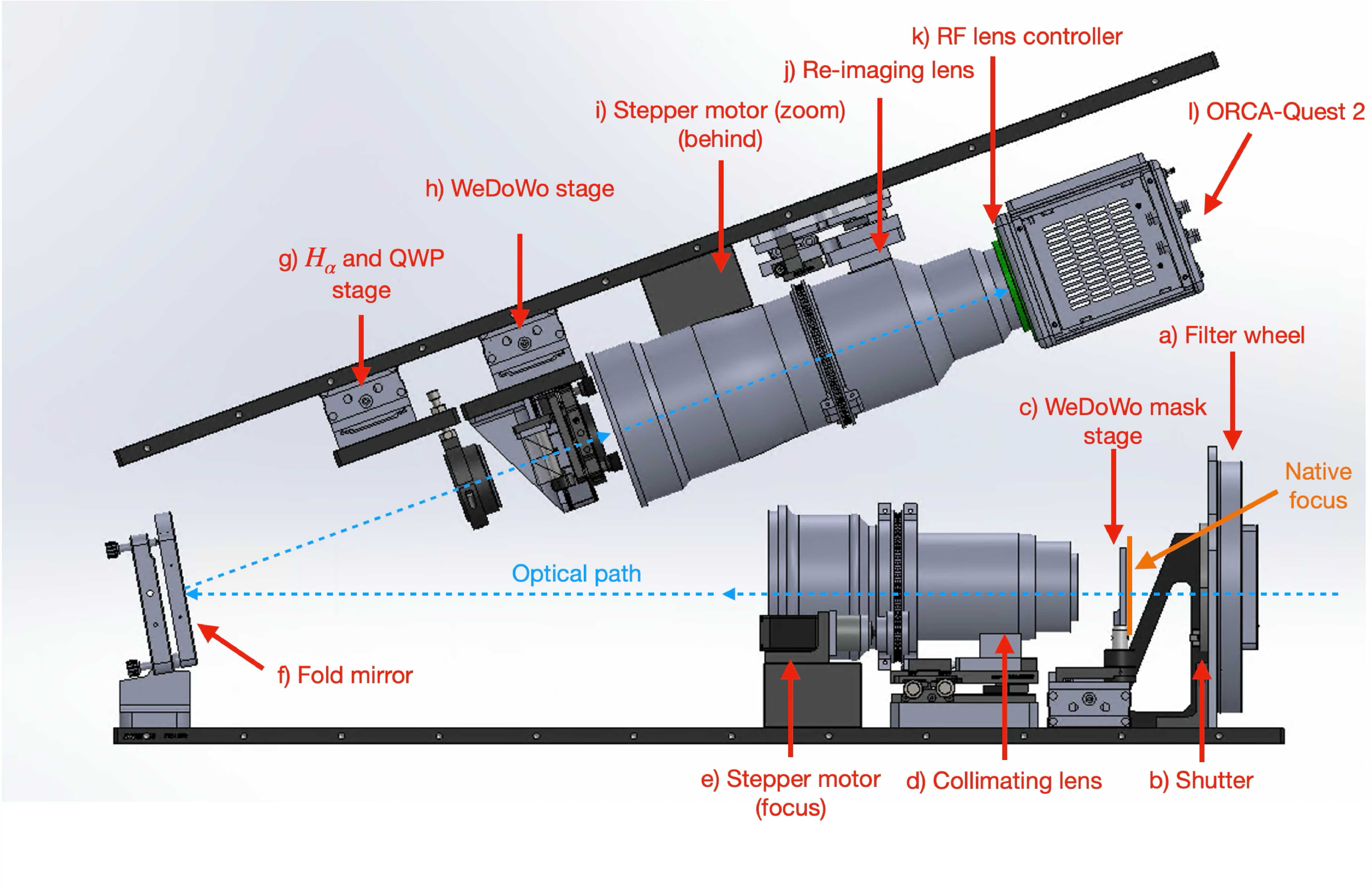
proto-Lightspeed uses commercial off-the-shelf (COTS) re-imaging optics to de-magnify the telescope's f/11 focal plane. A Canon EF 400mm f/4 lens re-collimates the light, while a Canon RF 100–300mm f/2.8 zoom lens provides adjustable magnification. This yields pixel scales between 0.017″–0.050″/pix, allowing switching between conventional imaging and speckle interferometry modes. proto-Lightspeed images a 1′ diameter field at up to 200 Hz (full field) or windowed fields at higher rates—up to 6600 Hz for a 1.6″ × 1′ strip.
Filters
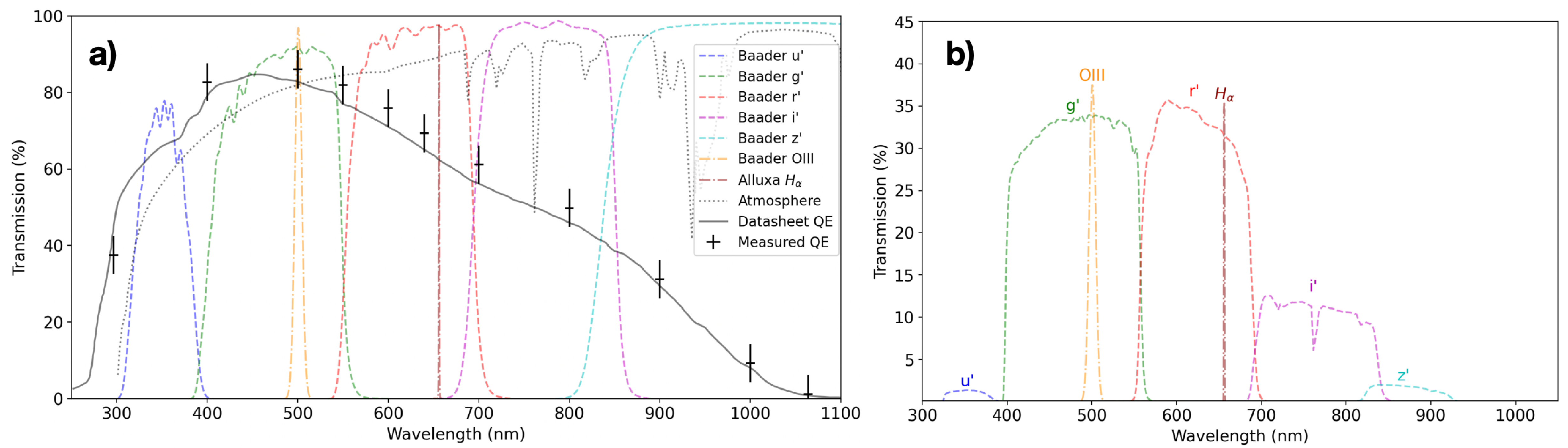
A seven-position filter wheel hosts Sloan u′, g′, r′, i′, z′ photometric filters and an OIII narrow-band filter (500.7 nm, 9 nm FWHM) for speckle interferometry. An additional Hα filter (653.3 nm, 1.1 nm FWHM) can be inserted into the collimated beam for narrow-band imaging. Note: the COTS re-imaging optics have poor throughput in u′ and z′, so these filters should generally not be used with proto-Lightspeed.
Mechanical and Electrical Design
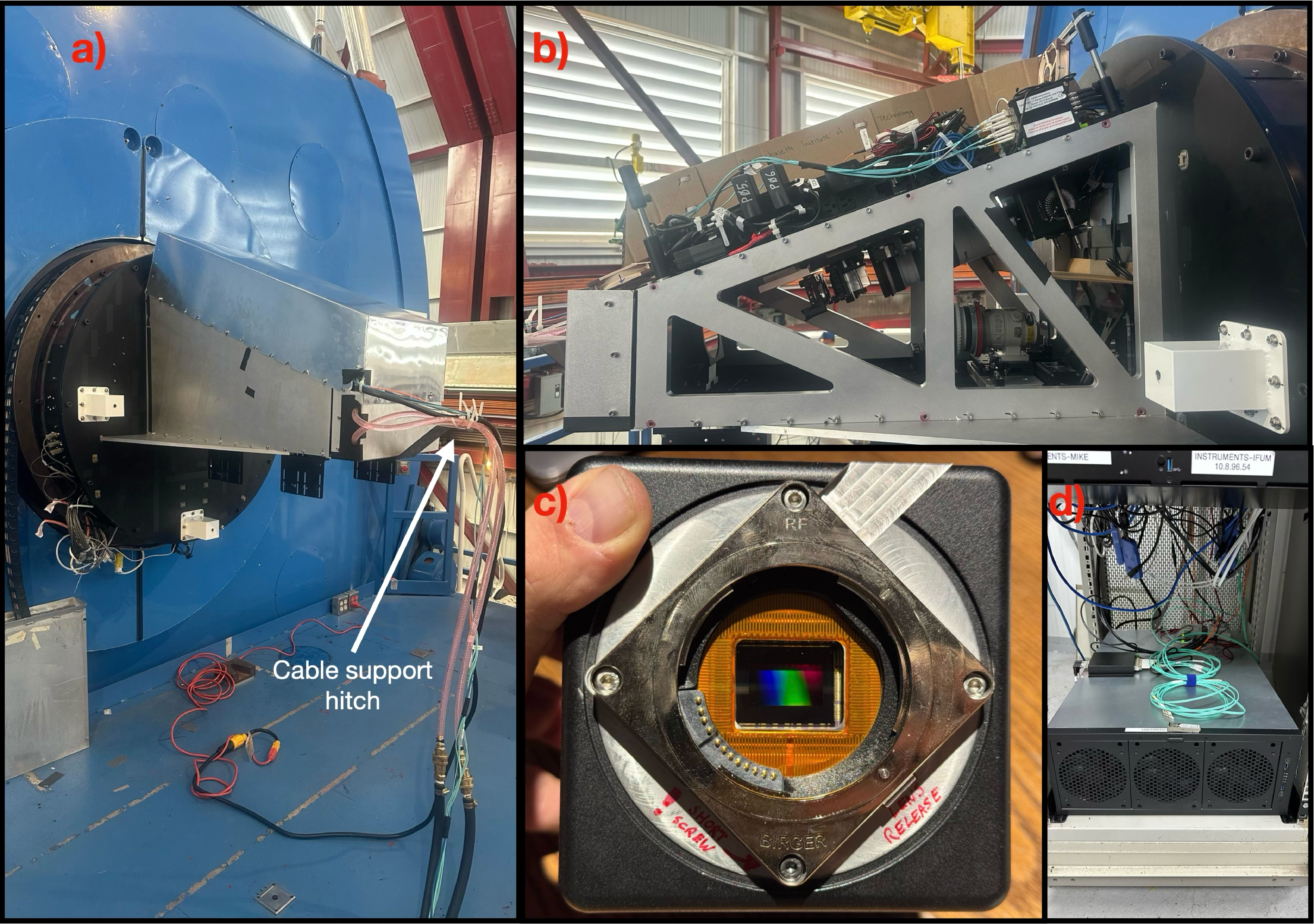
The optical components are mounted on two solid aluminum breadboards secured to a rotator plate for direct mounting to the Nasmyth East port. A cooling system channels cold air across electronic components and supplies fresh air to the camera's thermoelectric coolers, maintaining the sensor at its nominal operating temperature of −20°C. The instrument extends approximately 1 m from the port with a total mass of approximately 160 kg.
Detector
proto-Lightspeed employs the Hamamatsu ORCA-Quest 2 camera, featuring the HWK4123 CMOS sensor with 4096 × 2304 pixels (4.6 µm pixel size). This sensor achieves deep sub-electron read noise of 0.29 e⁻ RMS in ultra-quiet mode, approaching the photon-counting regime. The detector operates at −20°C with dark current of just 0.0072 e⁻/pix/s and peak quantum efficiency of ~85% at 460 nm. The full well capacity is approximately 7000 e⁻.
The camera offers two readout modes with different noise and speed characteristics:
| Readout Mode | Read Noise (e⁻ RMS) | Maximum Frame Rate (Hz) | |||
|---|---|---|---|---|---|
| Full Sensor 2304 × 4096 pix |
1′ Full Field 1200 × 1200 pix |
1.6″ × 1′ 32 × 1200 pix |
Absolute Max 4 × 4096 pix |
||
| Standard | 0.41 | 120 | 200 | 6600 | 19800 |
| Ultra-quiet | 0.29 | 25 | 48 | 1400 | 4200 |
Detector Nonlinearity Calibration
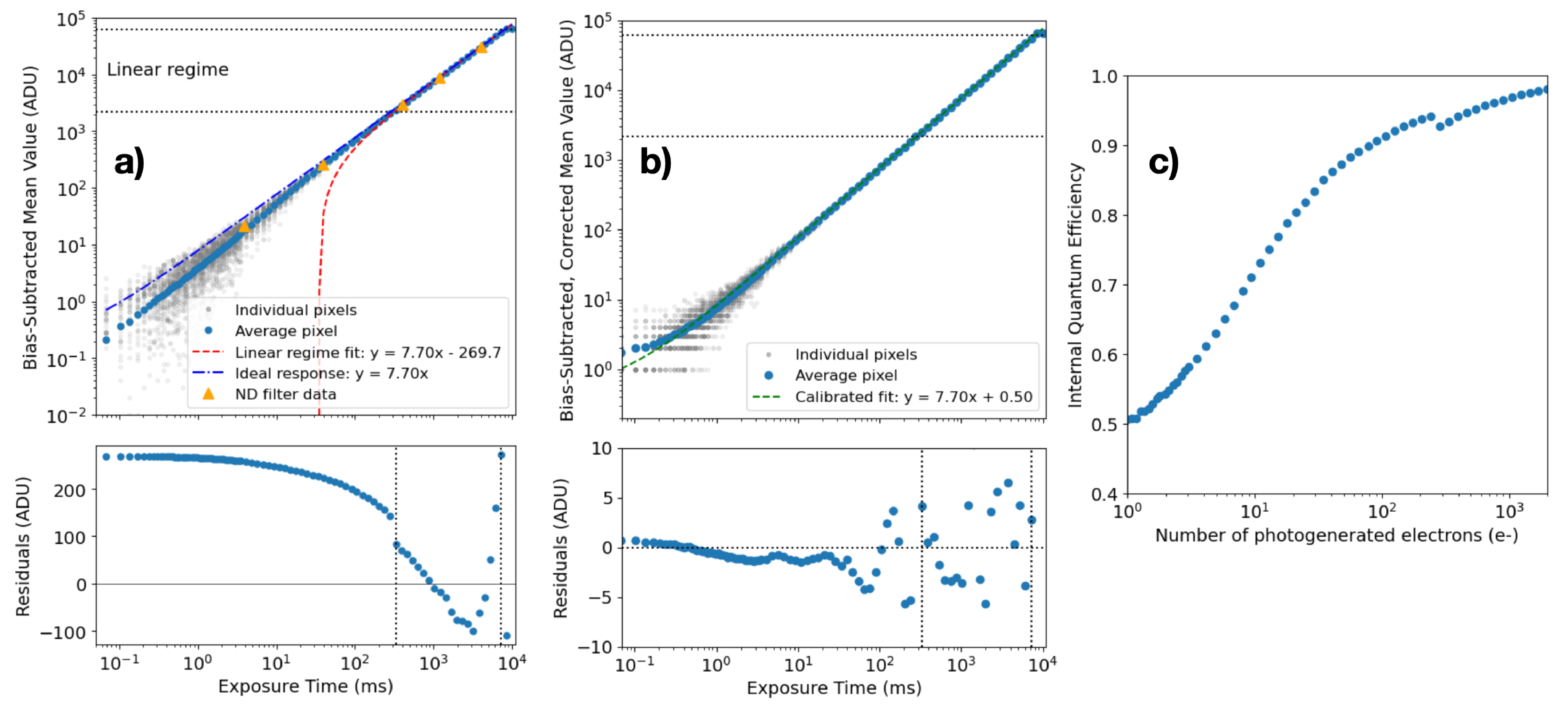
The ORCA-Quest 2 sensor exhibits nonlinear response at low signal levels due to incomplete charge transfer within each pixel. A per-pixel calibration corrects this nonlinearity across the full dynamic range. At very low signal levels, approximately 50% of photoelectrons are trapped; this efficiency improves asymptotically to nearly 100% at higher signal levels.
Performance
Measured Throughput
Zero points and throughput values measured during commissioning (referenced to SDSS):
| Filter | Zero Point (AB mag) | Throughput |
|---|---|---|
| g′ | 27.6 ± 0.1 | 19 ± 2% |
| r′ | 27.2 ± 0.1 | 21 ± 2% |
| i′ | 26.0 ± 0.1 | 7 ± 1% |
Image Quality
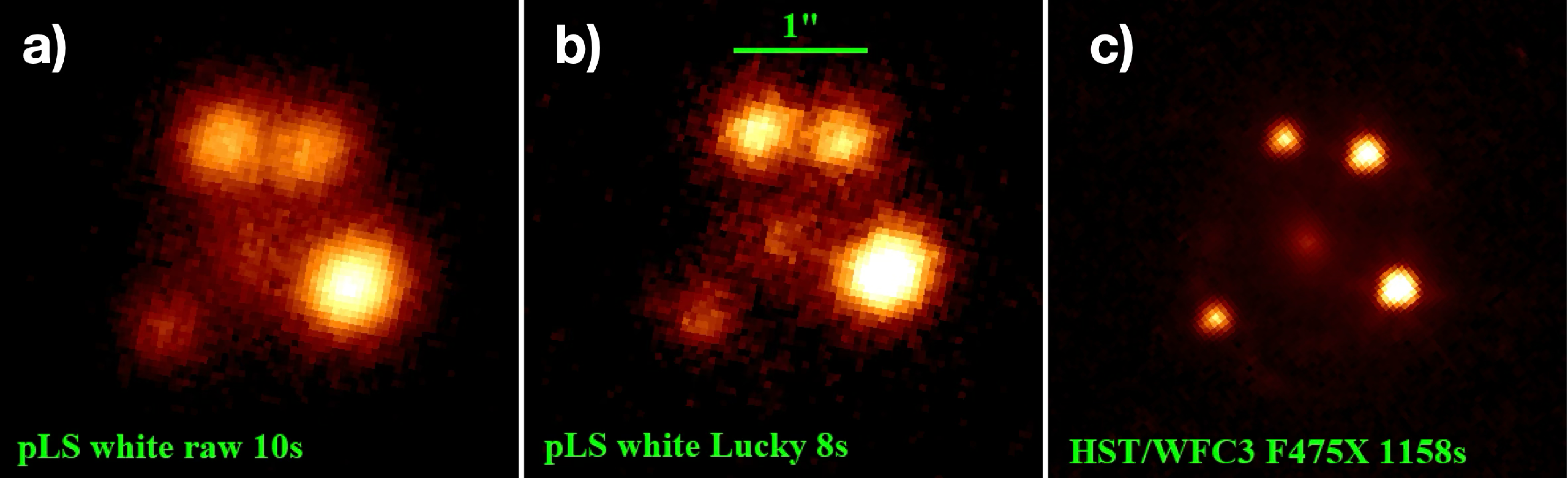
proto-Lightspeed achieves seeing-limited observations across its full field in g′, r′, and i′. No measurable image distortion was found across the field. Lucky imaging can further improve image quality—stacking the best 7% of 200 ms frames improved PSF FWHM from 0.51″ to 0.37″.
Timing System and Accuracy
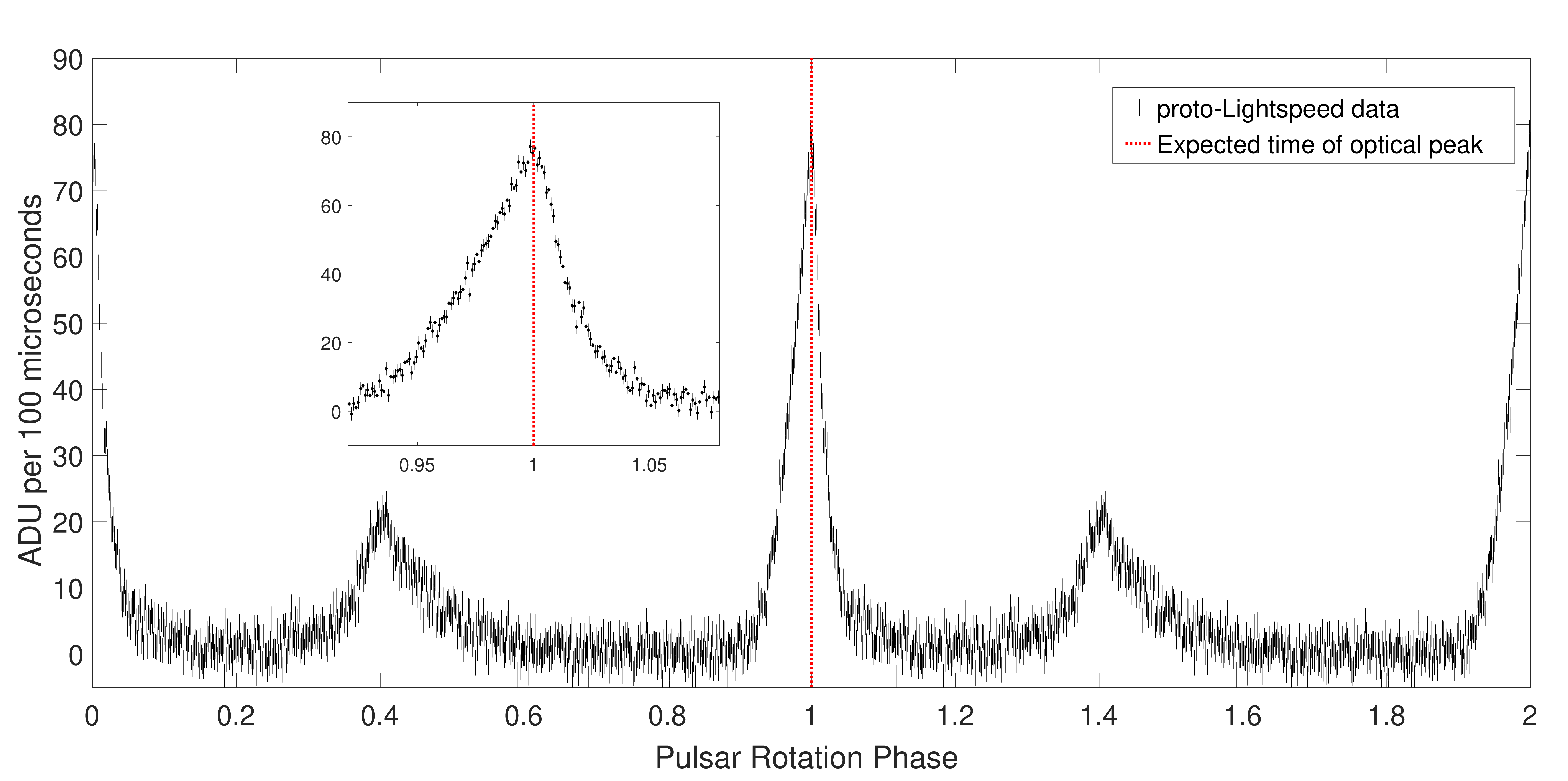
Absolute timing is achieved using a GPS-synchronized Meinberg TCR180PEX card that triggers exposures via a pulse-per-second signal and time-tags readout completion. This system delivers absolute timing accuracy better than 30 µs, verified on-sky using observations of the Crab pulsar. The optical pulse maximum was measured to occur within 5 ± 7 µs of the expected phase (using the Jodrell Bank radio ephemeris and the known ~255 µs optical-radio offset).
Photometric Precision
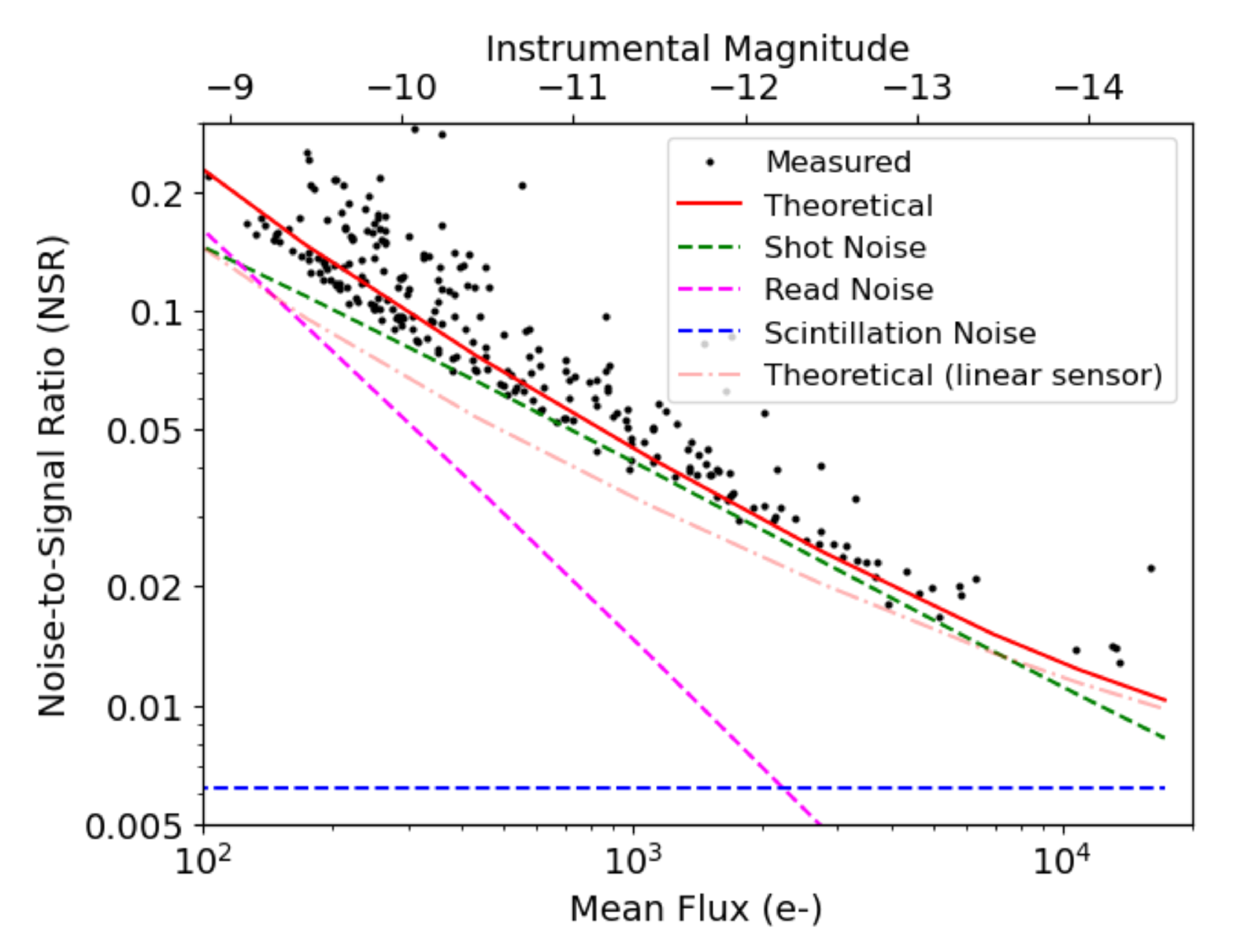
Photometric precision was verified using 500 images of globular cluster M30 with 30 ms exposures. The measured noise-to-signal ratio agrees well with theoretical predictions from the exposure time calculator.