Lightspeed: The Facility Instrument
Design of Lightspeed
Lightspeed will be a simultaneous five-channel imager intended to be a facility instrument on the Magellan Clay telescope.
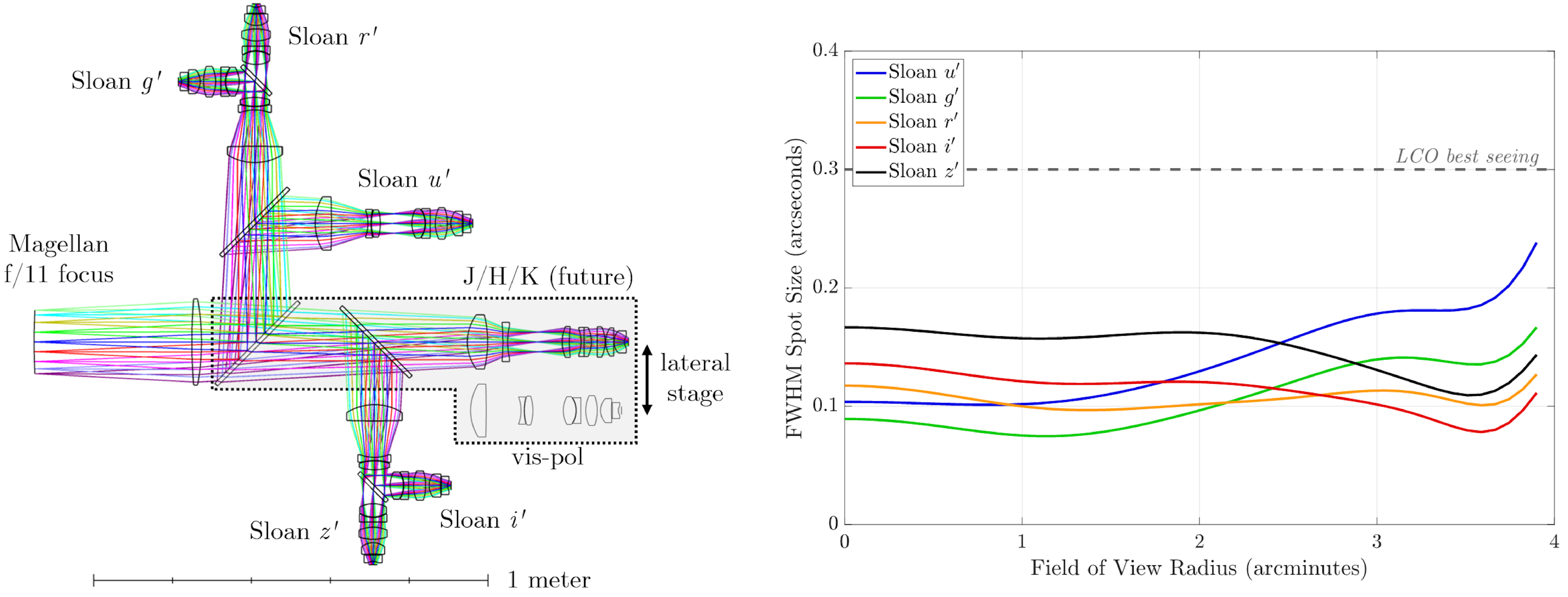
Optical Design
Lightspeed will use custom re-imaging optics with dichroic beam splitters to feed five channels simultaneously: u′, g′, r′, i′, and z′. Each channel will host its own ORCA-Quest 2 camera. Infrared light will pass through the dichroics, leaving the possibility for an additional photon-counting infrared arm using an HgCdTe linear-mode APD. An alternate "VIS-POL" channel will enable polarimetry and white-light imaging.
Field of View & Plate Scale
Lightspeed will deliver a 7′ × 4′ field of view—16 times larger than proto-Lightspeed—with a plate scale of 0.1″/pix. This larger plate scale will critically sample the PSF in good conditions, further reducing effective read noise for point sources. The larger field will enable studies of extended sources and provide an order-of-magnitude increase in sensitivity to serendipitous TNO occultations.
Predicted Performance
The custom optics will significantly improve throughput compared to proto-Lightspeed. Predicted zero points:
| Filter | Zero Point (AB mag) |
|---|---|
| u′ | 25.9 |
| g′ | 28.3 |
| r′ | 27.7 |
| i′ | 27.3 |
| z′ | 26.4 |